 en
en vi
vi es
es th
th pt
pt ms
ms ko
ko ru
ru fr
fr de
de ar
ar hi
hi id
id





Oct 16,2026
What are Splicing Tapes and Why Do They Matter
In paper converting, printing, film production, and other roll-to-roll processes, changing a material roll can interrupt production if the next roll cannot be joined quickly and securely. Splicing tape helps connect the end of one roll to the beginning of another, allowing the material to continue through the production line with less interruption. However, a tape that performs well on paper may not deliver the same results on plastic film, coated stock, or other difficult surfaces.
Choosing the right splicing tape involves more than comparing adhesive strength. The material being joined, the splicing method, line speed, and conditions further down the production process all affect the result. Understanding these factors helps manufacturers reduce splice failures, avoid unnecessary material waste, and select a tape that suits their actual operating requirements.
Splicing tape is an adhesive tape designed to join two sections of a continuous material, most commonly when one roll is running out and another needs to be introduced. It is widely used in manufacturing processes where paper, film, foil, labels, or other flexible materials are supplied in rolls.
Unlike general-purpose tape, splicing tape is selected for the demands of a particular joining operation. Some applications require an immediate bond so a new roll can be connected without stopping the line. Others need a thin, discreet joint that will pass through downstream equipment without disrupting the material or finished product.
A typical splicing tape consists of a backing or carrier, an adhesive layer, and, where required, a release liner. Some products use a double-sided construction to join two surfaces, while others are designed to secure the end of a new roll to the material underneath it. The construction varies according to the intended splice and the materials involved.
Adhesive behavior is especially important. The tape must make reliable contact with the substrate, develop sufficient holding power, and remain stable under the conditions encountered during processing. A tape with strong adhesion on ordinary paper may behave differently on a low-surface-energy film or a heavily coated material. This is why the substrate and production method should be identified before a product is selected.
In roll-to-roll manufacturing, material changes are a routine part of production. Without an effective splicing method, operators may need to stop equipment, remove the remaining material, thread the new roll through the line, and restart the process. These steps consume time and can increase scrap, particularly when the line requires careful tension control or precise material positioning.
The right splicing tape can help make roll changes more efficient by creating a dependable connection between the outgoing and incoming material. In suitable applications, the splice can pass through the production process without requiring a lengthy interruption. The actual benefit depends on the equipment, the joining method, and the tape's compatibility with the material.
A failed splice can have consequences beyond the immediate interruption. If the joint separates under tension, loose material may wrap around rollers, trigger a line stop, or require operators to remove damaged sections before restarting. An unsuitable tape may also leave adhesive residue, create an overly thick joint, or interfere with printing, coating, laminating, or other finishing operations.
For manufacturers, splicing tape is therefore a process component rather than simply a consumable. Its performance affects material handling, production stability, and the quality of the finished output. Selecting an appropriate product at the beginning can help prevent recurring problems that are difficult to solve by adjusting the equipment alone.
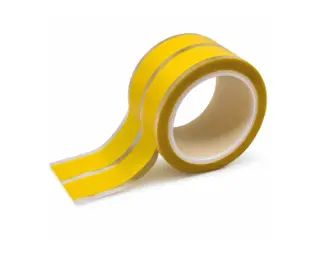
Splicing tapes are available in different constructions to accommodate various substrates and joining methods. The most useful way to distinguish them is to consider how the tape is built, what material it needs to join, and what happens to the splice after it enters production.
Single-sided splicing tape has adhesive on one side of the backing. Depending on its design, it may be used to secure a material end, reinforce a joint, or create a splice in which the adhesive contacts specific surfaces.
Double-sided splicing tape has adhesive on both sides of its carrier, or uses a transfer construction without a conventional backing. It can join two surfaces directly and is often considered when the joint needs to remain compact or when the splice design requires adhesive contact on both sides.
Neither construction is universally better. The correct option depends on whether the splice is a butt joint, an overlap, or another arrangement, as well as the thickness and surface characteristics of the material. For a production line with tight clearance, joint thickness may be just as important as holding power.
Paper splicing tape is used in paper converting, printing, and related operations where paper rolls must be joined during production. Depending on the process, the tape may need to bond to coated or uncoated paper, withstand line tension, or pass through subsequent converting equipment.
Paper grades can differ considerably in surface texture, coating, porosity, and dust levels. These differences affect how an adhesive makes contact with the surface. A tape that performs reliably on one grade should therefore be tested before being introduced to another, especially when the production speed or paper treatment changes.
Some paper-processing applications also require repulpable splicing tape. These products are designed for specific paper-recycling or repulping processes, where the splice must be compatible with the intended recovery system. Repulpability should be confirmed against the relevant process requirements rather than assumed from the fact that a tape is used on paper.
Film splicing tape is used to join flexible materials such as plastic films and other web materials processed in rolls. Applications may include flexible packaging, coating, laminating, and converting.
Film surfaces can be more challenging to bond than paper, particularly when the material has a low surface energy or carries a release treatment. Film thickness, surface additives, coatings, and processing conditions can all influence adhesion. In these situations, choosing a tape based only on its performance on paper is unlikely to provide a reliable basis for selection.
The tape must also suit the next stage of production. A splice that holds during roll handling may still be unsuitable if it creates excessive thickness, leaves residue, or cannot withstand the temperature and tension encountered later in the line.
A flying splice joins a new roll to the running web while the production line continues operating. It is used in applications where stopping the line for every roll change would be impractical or costly. The tape and splice arrangement must work with the equipment's joining mechanism, web speed, and material characteristics.
Flying splice tape is not simply a stronger version of ordinary splicing tape. The joint may need to form quickly and reliably under tightly controlled conditions. Depending on the application, the splice may also need to remain secure during acceleration, tension changes, or contact with downstream rollers.
Manufacturers should confirm that a product is designed for the specific flying-splice method in use. A tape intended for manual or stationary splicing should not be assumed suitable for a high-speed automatic process.
Splicing tape is used wherever flexible materials are supplied in rolls and must remain connected as production continues. The requirements vary by industry, so the application is often a better starting point than the tape category alone.
In paper manufacturing and printing, splicing tape connects paper rolls during printing, converting, and finishing. The key considerations may include adhesion to coated or uncoated stock, joint thickness, line speed, and compatibility with downstream processes. For paper destined for recycling, the manufacturer may also need to verify whether a repulpable solution is required.
In flexible packaging and film converting, the tape must bond reliably to the actual film surface. Polyethylene, polypropylene, polyester, and laminated structures can have different adhesion requirements, so a product suitable for one film should not automatically be used on another. The splice must also tolerate the tension and handling conditions of the production line.
In coating and laminating operations, the joint may pass through heated zones, rollers, or other processing stages. Here, the relevant questions include whether the adhesive can withstand the actual process temperature, whether the splice will remain secure under tension, and whether the tape could affect the coating or finished surface.
In label and release-liner converting, a splice may need to pass through equipment that handles relatively thin materials at high speed. Joint thickness, release characteristics, and the risk of adhesive transfer can become important, depending on the construction and the next production step.
Across these applications, the same principle applies: the tape must be compatible with both the material being joined and the process that follows the splice.
The most reliable way to select splicing tape is to start with the production conditions, then match the tape's construction and adhesive properties to those requirements. A product that works well in a low-speed manual operation may not be suitable for automatic splicing at higher speeds.
Start by identifying the exact material to be joined. Consider whether it is paper, coated paper, plastic film, foil, a laminate, or another flexible substrate. Surface treatments, coatings, dust, moisture, and release agents may affect adhesion even when two materials appear similar.
If the material changes between production runs, test the tape on each relevant grade rather than relying on a result from a single sample. This is particularly important when moving between coated and uncoated paper or between films with different surface properties.
Determine whether the joint will be made manually, during a stationary roll change, or through a flying-splice system. The method influences how quickly the adhesive must bond, how the joint is positioned, and how much mechanical stress it experiences.
Line speed alone does not determine which tape will work, but it helps define the performance requirements. For high-speed applications, the tape must be compatible with the equipment's splice geometry and operating sequence. Trial runs should reflect the actual production speed wherever practical.
The splice may encounter heat, changing web tension, roller pressure, or other conditions after the initial joint is formed. Review the complete process rather than focusing only on the temperature or tension at the moment of application.
For example, a tape may bond successfully at room temperature but lose holding power when exposed to a heated coating stage. In another process, the main concern may be whether the joint can pass through rollers without lifting or transferring adhesive. The required properties should be defined by the actual production conditions.
A splice can remain firmly attached yet still cause problems if the joint is too thick for the equipment or creates a defect in the finished material. Where the splice passes through narrow clearances or sensitive finishing stages, verify the complete joint construction rather than considering the tape thickness alone.
Removal and residue requirements also depend on the application. Some processes allow the splice to travel through the line and be discarded later, while others are sensitive to adhesive transfer or contamination. Confirm what happens to the joint at the end of the process before choosing a tape.
Laboratory adhesion results are useful, but they do not always predict performance on a running production line. Before full-scale use, test the tape on the intended substrate using the actual splice configuration. Where relevant, include the operating speed, temperature, web tension, and downstream equipment in the evaluation.
Record whether the splice remains secure, whether the joint passes through the equipment smoothly, and whether any residue, lifting, or material damage occurs. If the process is prone to variation, repeat the trial across representative material batches and operating conditions. This provides a stronger basis for selection than relying on a single successful hand test.
Splicing failures often result from a mismatch between the tape and the process rather than from adhesive strength alone.
One common cause is poor substrate compatibility. Dusty paper, coated surfaces, low-surface-energy films, and materials carrying release treatments may require different adhesive performance. If the tape cannot make sufficient contact with the surface, the joint may fail even when the tape performs well on a different substrate.
Another issue is an unsuitable splice design. A tape may be appropriate for a stationary overlap but fail when used in a process that requires a thin butt splice or a high-speed flying splice. Joint geometry, placement accuracy, and the way the web is tensioned all affect the load applied to the connection.
Incorrect application conditions can also reduce reliability. Inconsistent pressure, contamination, wrinkles, or poor alignment may prevent the adhesive from making full contact. Temperature and humidity can further affect the tape or substrate, depending on the materials involved.
Finally, the splice may be exposed to conditions beyond the tape's intended operating range. Heat, tension changes, roller contact, or subsequent processing can reveal weaknesses that were not apparent immediately after application. When a failure occurs, it is useful to examine where and when the joint separated, what the adhesive remained attached to, and whether the failure occurred before or after a downstream process.
A structured investigation of the substrate, splice design, application method, and operating conditions is usually more effective than simply switching to a tape described as having higher adhesion.
The right splicing tape depends on the material, the way the joint is formed, and the conditions the splice must withstand. Paper, film, and other roll-fed materials have different surface characteristics, while manual splicing and high-speed flying splicing place different demands on the adhesive and joint design.
For purchasing teams and production engineers, the most useful starting point is a clear description of the application: substrate type, splicing method, line speed, operating temperature, and any requirements for joint thickness, removal, or repulpability. With these details established, it becomes easier to compare suitable products and validate performance before moving into regular production.
Jantape supplies adhesive tape solutions for industrial applications, including splicing applications involving paper and leather. When evaluating a suitable product, manufacturers should confirm the available construction and adhesive options against their specific material and process requirements. A well-matched splice can help maintain production continuity, reduce avoidable interruptions, and support more consistent material handling.