 en
en vi
vi es
es th
th pt
pt ms
ms ko
ko ru
ru fr
fr de
de ar
ar hi
hi id
id





Oct 10,2026
Double-Sided Tape vs. Transfer Tape: What Is the Difference?
Adhesive tape is used at several points in lithium battery manufacturing, but it is rarely there simply to “stick something together.” In a battery cell or pack, tape may provide electrical insulation, temporary fixation, edge protection, component positioning, flame retardancy, or protection against mechanical damage. The right tape therefore depends on what the process is trying to control.
For battery manufacturers, the more useful question is not which tape has the strongest adhesive. It is where the tape will be applied, what it will contact, how long it needs to remain in place, and what conditions it must withstand during assembly and operation.
Battery production involves a sequence of processes in which materials are handled, assembled, compressed, welded, insulated, and packaged. Tape requirements change accordingly. A material that works well for temporary component fixing may be unsuitable for electrical insulation, while a high-temperature insulation tape may be unnecessary for a low-stress positioning step.
The main applications can be grouped into four functions: fixing and positioning, electrical insulation, protection, and process control.
| Battery manufacturing stage | Typical tape function | Main requirement |
|---|---|---|
| Cell assembly | Component fixing and positioning | Stable adhesion, clean removal |
| Tab and electrode area | Electrical insulation | Dielectric strength, dimensional stability |
| Cell wrapping | Surface and edge protection | Conformability, abrasion resistance |
| Module assembly | Component fixation and insulation | Reliable bonding, flame retardancy |
| Pack assembly | Insulation and protection | Thermal resistance, long-term stability |
| Labeling and identification | Product marking | Printability, adhesion, durability |
This distinction matters because battery manufacturing tape is exposed to very different stresses depending on its location. A tape applied before welding may need to tolerate heat from the process, while a tape used after cell assembly may primarily need to maintain insulation without shifting.
The electrode tab is a particularly sensitive area because it creates a direct transition between the internal electrical structure of the cell and the external connection point. Tape around this area must provide insulation without interfering with tab positioning, welding, or subsequent assembly.
Tab Insulation Tape is commonly selected for its combination of dielectric performance, dimensional stability, adhesion, and resistance to the conditions encountered during cell assembly. Excessively soft adhesive can migrate under pressure, while an overly rigid backing may not conform well around the tab geometry.
For lithium battery applications, manufacturers should evaluate:
The objective is not simply to create a thicker insulation layer. A tape that is difficult to position accurately can create wrinkles, exposed edges, or unnecessary material overlap, all of which complicate automated assembly.
For applications requiring customized dimensions or material combinations, Custom Tab Insulation Tape can be developed around the tab geometry and production method rather than forcing a standard roll into a process it was not designed for.
Battery cells contain components that must remain accurately positioned before the surrounding structure provides permanent mechanical support. Tape can be used for temporary fixation, component positioning, and securing layers during assembly.
This is particularly relevant when a component must stay in position while another manufacturing operation takes place. The tape needs enough initial tack to prevent movement, but excessive adhesion can create problems when components need to be repositioned or when tape removal is part of the process.
A practical selection should consider three separate adhesive characteristics:
These properties are not interchangeable. A tape with very high peel adhesion may still perform poorly if it does not provide sufficient holding power under the actual load direction.
For automated battery assembly, consistency is often more important than achieving the highest possible adhesion number. Variations in adhesive coating, backing thickness, or release characteristics can affect how reliably the tape feeds and applies from roll to roll.
Electrical insulation is one of the most important roles of adhesive tape in battery manufacturing. However, simply choosing a tape made from an electrically insulating material does not guarantee reliable performance in a battery application.
The complete tape construction matters. The backing material, adhesive system, thickness, dielectric strength, dimensional stability, and resistance to the surrounding environment all contribute to insulation performance.
For example, a tape may have excellent dielectric strength under laboratory conditions but perform poorly if its adhesive softens at the process temperature or if the backing stretches during application. Likewise, a mechanically strong tape is not necessarily the best choice when the application requires precise insulation around a small component.
Different battery components create different insulation challenges. Tabs, busbars, cell surfaces, terminals, and module structures may require different tape constructions.
| Application | Important properties | Potential concern if poorly selected |
|---|---|---|
| Tab insulation | Dielectric strength, conformability | Electrical exposure or poor coverage |
| Cell surface insulation | Adhesion, dimensional stability | Lifting or edge separation |
| Busbar insulation | Electrical isolation, heat resistance | Short-circuit risk |
| Module component fixing | Adhesion, mechanical stability | Component movement |
| Pack-level protection | Insulation, durability, flame resistance | Long-term degradation |
This is why Battery Termination Fixation Tape and other battery-specific constructions should be evaluated as part of the complete electrical and mechanical design rather than treated as generic consumables.
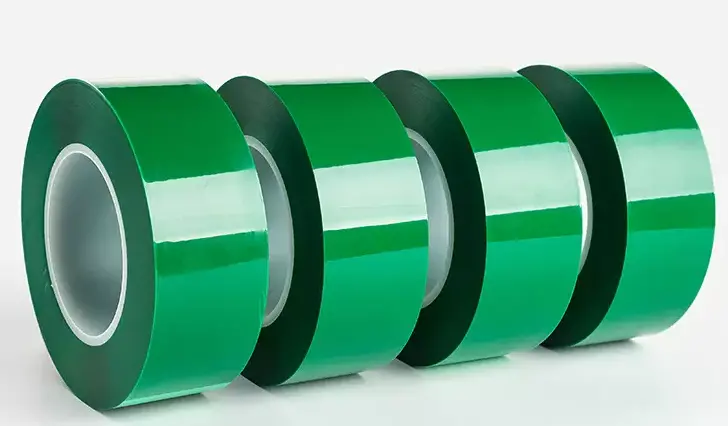
Termination areas often require a combination of fixation and insulation. Tape can help secure the end of a wrapping layer, protect an exposed transition, or prevent movement at a termination point.
The adhesive must maintain sufficient contact without squeezing out excessively during winding, pressing, or handling. The backing also needs to remain stable enough that the tape does not shrink, split, or expose the underlying material.
For manufacturers working with different cell formats, battery termination tape may need to be customized for width, thickness, adhesive strength, and temperature performance. A narrow tape that works well on one cell design may not provide adequate overlap on another.
The selection should therefore start with the termination geometry and assembly method rather than with a tape category alone.
As battery systems become larger, tape may be used around components where flame-retardant performance is an important part of the overall safety strategy. This is particularly relevant when tape is positioned near electrical connections, insulation structures, or areas where heat may accumulate.
Flame-Retardant Battery Tape should not be selected solely because the product description contains the words “flame retardant.” Buyers should verify the applicable test standard, construction, thickness, and actual certification or test documentation.
There is also a difference between flame retardancy and thermal resistance. A tape can resist elevated temperature without necessarily providing the required flame behavior, and a flame-retardant construction may still have limitations at high continuous operating temperatures.
For this reason, battery manufacturers should define the requirement in terms of the actual application: temperature exposure, ignition behavior, electrical insulation, adhesive stability, and duration of exposure.
Battery manufacturing introduces a wider range of materials than many conventional assembly applications. Depending on the cell and process, tape may contact metals, coated foils, polymers, insulation films, painted surfaces, or other adhesive-backed materials.
A tape that bonds strongly to one substrate can behave very differently on another. Surface energy, cleanliness, coating condition, roughness, and pressure during application all affect the final bond.
This is especially important when tape is applied to surfaces that may carry traces of processing oils or contamination. In production, inconsistent surface preparation can create more failures than a modest difference in nominal adhesive strength.
For production validation, manufacturers should test the tape on the actual substrate and under the actual process conditions, including application pressure, temperature, dwell time, and removal requirements.
Battery environments can expose materials to conditions that are not represented by ordinary tape applications. If the tape is positioned where it may encounter electrolyte, elevated temperatures, compression, or prolonged contact with adjacent materials, compatibility testing becomes important.
The question is not simply whether the tape remains physically attached. Engineers should also look for:
For a new battery design, accelerated testing can reveal failure modes before the tape enters mass production. This is particularly valuable when the tape is difficult to replace after cell or module assembly.
A common purchasing mistake is to specify one “battery tape” for an entire production line. A cylindrical cell, pouch cell, and prismatic cell may use tape differently, and even two products using the same cell format can have different requirements because of their assembly processes.
A better approach is to map the tape requirement to each manufacturing operation.
For example, a cell manufacturer may need Battery Swelling Tape for one stage, a dedicated insulation tape around tabs, and a separate fixing tape for temporary positioning. The products may all be classified broadly as battery adhesive tapes, but their performance requirements are not the same.
The same principle applies to energy-storage systems. A tape selected for a compact consumer battery should not automatically be transferred to an industrial energy-storage module without validation.
Technical documentation is more useful when it reflects the actual production requirement. Instead of asking only for a product catalog, battery manufacturers can provide the supplier with the application details and request a recommendation based on those conditions.
A useful technical inquiry should include:
The supplier should then be able to provide technical data covering thickness, backing material, adhesive type, adhesion, tensile strength, dielectric performance, temperature range, and relevant compliance documentation.
For manufacturers sourcing from China, working directly with a Battery Tape Manufacturer can also make customization easier when standard tape dimensions do not match the production process.
Tape is inexpensive compared with the battery itself, but a tape failure can have consequences far beyond the cost of the roll. Poor adhesion can lead to movement during assembly. Insufficient insulation can create electrical risks. Adhesive migration can contaminate adjacent components. Dimensional instability can create problems in automated application.
For this reason, tape qualification should be treated as a process-material validation rather than a simple purchasing decision.
A practical validation program should compare candidate tapes under the conditions they will actually encounter. Peel adhesion, holding power, insulation performance, temperature exposure, residue, dimensional stability, and compatibility with the substrate should all be considered together.
The best battery adhesive tape is therefore not necessarily the strongest or thickest option. It is the construction that provides the required function without creating problems elsewhere in the manufacturing process. When tape is selected according to the exact battery structure and production step, it becomes a controlled part of the manufacturing system rather than an afterthought.