 en
en vi
vi es
es th
th pt
pt ms
ms ko
ko ru
ru fr
fr de
de ar
ar hi
hi id
id





Sep 24,2026
Custom Lens Mold Tape for Optical Lens Production
Standard mold tape can work well when the mold geometry, resin system, curing cycle, and removal process remain within an established range. Production becomes more complicated when one of these conditions changes. A curved mold may need better conformability, a new resin may alter adhesive behavior, or a longer curing cycle may create residue that was not present before.
In these situations, custom lens mold tape is not simply a different tape size. The tape needs to be developed around the actual production conditions so that it can maintain positioning during molding, remain stable during curing, and release cleanly during demolding.
A standard tape specification is normally designed around a defined combination of backing, adhesive, thickness, width, and performance characteristics. It can be an efficient choice when the manufacturing process is already established and the tape has been properly qualified.
Problems arise when the production environment falls outside those conditions. For example, a tape that works on a relatively flat mold may not conform properly to a sharply curved surface. A tape that performs well with one resin formulation may show different adhesion or removal behavior after exposure to another curing chemistry.
The need for customization usually becomes apparent through a specific production problem rather than a desire for a more sophisticated product. Common triggers include:
· Mold geometry: curved, narrow, irregular, or difficult-to-access contact areas
· Process conditions: higher temperatures, longer curing cycles, or changes from thermal to UV curing
· Material changes: new resin formulations, high-index materials, or different mold substrates
· Production requirements: automated application, tighter dimensional control, lower residue, or faster removal
The purpose of customization is therefore to bring the tape's performance into the required production window rather than to maximize a single specification.
A tape is a layered system. Changing its performance can involve the backing, adhesive, dimensions, or converting specifications rather than simply increasing adhesive strength.
Production requirement | Possible customization | Main purpose |
Curved mold surface | Backing flexibility and thickness | Improve conformability |
Long or demanding curing cycle | Adhesive and backing selection | Maintain stability during processing |
Difficult removal | Adhesive formulation and peel behavior | Control release force |
Narrow contact area | Tape width and thickness | Improve application accuracy |
Specialized resin | Adhesive compatibility | Reduce unwanted interaction with the process |
Automated application | Roll dimensions and dimensional stability | Improve feeding and placement consistency |
Strict mold cleanliness | Adhesive system | Reduce adhesive transfer and residue |
The appropriate combination depends on the process. A change that improves one characteristic can affect another, so customization should be treated as a balance between holding performance, thermal stability, conformability, and removal.
The backing provides much of the tape's mechanical behavior. Its flexibility affects how well the tape follows the mold surface, while its dimensional stability affects how consistently it remains in position during processing.
For a curved lens mold, excessive stiffness can make the tape difficult to apply without bridging or wrinkling. On the other hand, a backing that is too thin or mechanically unstable may be difficult to handle and may not maintain its dimensions during curing.
This makes lens mold tape thickness a process parameter rather than a specification that can be selected independently. The appropriate thickness depends on mold geometry, application method, required mechanical strength, and the thermal conditions the tape will experience.
Adhesive customization is more complicated than simply selecting a higher or lower peel value.
During lens molding, the adhesive may need to provide sufficient holding force during mold assembly and resin filling while remaining removable after curing. Its behavior can also change with temperature, contact time, pressure, and exposure to the resin system.
For this reason, a custom optical lens tape may require adjustment of the adhesive formulation or its performance profile rather than simply increasing initial tack.
The target is a stable adhesive response throughout the production cycle:
Application → mold positioning → resin filling → curing → demolding → removal
A tape that has very high initial adhesion but becomes difficult to remove after curing may create more production problems than it solves.
Customization can also involve the physical format of the tape.
For manual application, operators may need a specific width that fits the mold edge without excessive trimming. Automated production may require tighter control of roll width, core size, roll length, or dimensional consistency.
These details can have a direct effect on production efficiency. A tape with suitable adhesive performance can still be inconvenient if its dimensions are poorly matched to the application equipment.
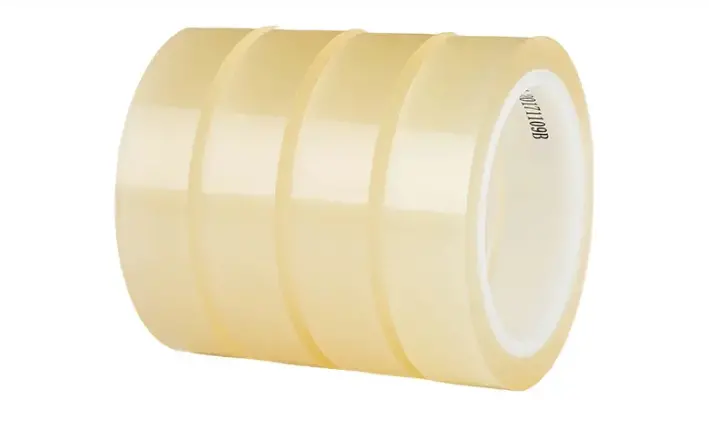
Not every lens manufacturing process needs a customized product. If a standard tape has already been validated for the mold, resin, curing cycle, and removal process, changing the product may introduce unnecessary qualification work.
Customization becomes more relevant when a repeatable production problem cannot be solved by adjusting the process itself.
Curved surfaces, narrow edges, and irregular contact areas can create problems that do not appear during testing on a flat surface.
The tape needs to maintain continuous contact without excessive tension or local lifting. If the backing cannot follow the mold contour, the adhesive may not perform consistently across the entire contact area.
For these applications, the relationship between backing flexibility, thickness, contact pressure, and mold geometry is more important than a single adhesion value.
Changing the resin or curing process can change the conditions experienced by the tape.
A new process may involve:
· Different resin chemistry
· Different curing temperature or time
· Thermal, UV, or combined curing
· A different heating and cooling profile
· Greater exposure to reactive components
A tape validated for one resin system should not automatically be treated as qualified for another. The same principle applies when a manufacturer changes the curing cycle.
This is particularly relevant when developing custom lens mold tape for resin lenses, because resin formulations and curing conditions can vary significantly between production lines.
High-index resin systems can introduce additional material and processing considerations. The adhesive needs to remain compatible with the process while maintaining the required holding and removal characteristics.
If the production issue is related specifically to high-index lens manufacturing, customization may involve more than changing the tape dimensions. Adhesive compatibility, thermal performance, and post-curing removal may all need to be evaluated.
For background on the process-specific requirements of these applications, see specialized mold tape for high-index lenses.
A useful customization project starts with the production process, not with a generic request such as “high-temperature tape” or “strong adhesive tape.”
The tape supplier needs enough information to understand what the product will experience.
Important information includes:
· Mold material, surface finish, geometry, and treatment
· Lens material and resin formulation
· Tape contact area and application method
· Curing temperature, duration, and curing method
· Required holding stability during molding
· Demolding procedure
· Acceptable level of adhesive residue
· Current tape specification, if the custom product is replacing an existing one
The more precisely these conditions are defined, the easier it is to identify which tape characteristics actually need to change.
Once the requirements are established, the development work can focus on the relevant parts of the tape construction.
A customization project may involve changes to the:
Backing → Adhesive → Thickness → Width → Roll format
Not every project requires changes to every component. If the existing backing already provides sufficient dimensional stability, for example, the development effort may focus primarily on adhesive behavior.
This approach is more practical than changing several variables simultaneously because it makes subsequent testing easier to interpret.
Sample development should lead to testing under conditions that represent the customer's actual process.
A tape that looks promising in a laboratory test may behave differently when applied to the actual mold and exposed to the production resin and curing cycle.
For that reason, a meaningful sample trial should reproduce as many of the following conditions as possible:
· Actual mold surface
· Actual resin or a representative formulation
· Actual tape application method
· Actual curing profile
· Actual demolding procedure
The purpose of the trial is not simply to confirm that the tape sticks. It is to determine whether the tape solves the original production problem without creating a new one.
A customized product should be qualified against measurable production requirements before it moves into regular manufacturing.
Test stage | What to evaluate | Typical acceptance concern |
Application | Contact and conformability | Wrinkles, gaps, lifting |
Mold assembly | Holding stability | Mold movement or edge lifting |
Resin filling | Positioning and sealing | Leakage or displacement |
Curing | Thermal and dimensional stability | Shrinkage, deformation, adhesive change |
Demolding | Peel behavior | Excessive force or tape tearing |
Removal | Surface condition | Residue or adhesive transfer |
Repeated cycles | Consistency | Variation between cycles or lots |
Standardized laboratory tests are useful for comparing tape properties, but the actual mold interface can be substantially different from a standard test substrate.
This is especially important when the mold has a particular surface finish, coating, curvature, or cleaning process.
ASTM D3330/D3330M provides standardized methods for measuring peel adhesion of pressure-sensitive tape. Such testing can establish useful comparative data, but production qualification should still account for the actual application conditions.
A simple maximum-temperature test may not represent what happens during production.
For example, the tape may experience a gradual temperature increase, remain at an elevated temperature for an extended period, and then cool before removal. Adhesive behavior can change throughout this sequence.
The test should therefore consider the complete temperature-time profile, not just the highest temperature.
The tape should be inspected after curing rather than only before it enters the oven or curing equipment.
The evaluation should include:
· Peel force
· Tape integrity
· Adhesive transfer
· Mold cleanliness
· Additional cleaning requirements
· Changes in mold surface condition
ISO 29862:2024 provides methods for determining peel adhesion properties of self-adhesive tapes and can be useful as a reference when establishing comparative testing procedures.
However, the most useful acceptance criteria should still be connected to the customer's production requirements.
One successful sample does not necessarily mean the tape is ready for mass production.
Repeated trials can reveal problems that appear only after multiple cycles or across different tape lots. This matters particularly for high-volume lens manufacturing, where a small variation in residue, peel force, or dimensional stability can create significant rework or cleaning costs over time.
Customization should not automatically be treated as an upgrade. A standard product may be the more efficient option when it already satisfies the application.
Factor | Standard lens mold tape | Custom lens mold tape |
Application | Established production conditions | Specific or unusual conditions |
Specification | Existing configuration | Adjustable within development capability |
Mold geometry | Common geometries | Complex or specialized geometries |
Resin system | Previously qualified systems | New or specialized systems |
Development | Faster implementation | Requires sampling and qualification |
Cost structure | Usually simpler | May involve development and custom converting |
Validation | Existing application data may help | Customer-specific testing is required |
The decision should therefore be based on the production problem. If a standard tape already provides stable molding, curing, and removal performance, customization may add complexity without providing a meaningful benefit.
A supplier providing customization should be able to connect tape design with the actual lens manufacturing process. Simply offering several adhesive strengths or tape thicknesses is not the same as application-specific development.
When evaluating a lens mold tape manufacturer, procurement and engineering teams should look at several capabilities:
· Adhesive formulation and coating capability
· Backing material selection
· Thickness and dimensional control
· Slitting and converting capability
· Laboratory testing and quality control
· Application-specific sample development
· Production consistency between lots
· Ability to support OEM or customized specifications
It is also useful to evaluate whether the supplier understands the complete application rather than only the tape itself. In optical lens production, mold preparation, positioning, resin filling, curing, and demolding are interconnected. The mold tapes for optical lens used in production therefore need to be considered within that complete process.
A detailed RFQ can shorten the development cycle because the supplier has a clearer technical starting point.
For custom lens mold tape, the request should ideally include:
1. Lens and mold information — lens material, resin type, mold material, surface finish, geometry, and contact area.
2. Process conditions — application method, curing method, temperature profile, curing duration, and number of cycles.
3. Performance requirements — holding stability, conformability, removal force, residue tolerance, required dimensions, and any existing tape specification.
If the tape is replacing a product already in production, providing the current tape sample or specification can also be useful. It gives the supplier a reference point for identifying which properties need improvement rather than redesigning the entire product without a defined target.
Customization makes the most sense when there is a clear production requirement that an existing standard tape cannot consistently satisfy.
Typical cases include:
· A mold geometry causes repeated application or lifting problems
· A new resin or curing cycle changes tape performance
· Residue increases mold cleaning time
· Automated equipment requires specific tape dimensions
· A specialized lens process needs a different adhesive performance profile
· Production volume makes small improvements in yield or process stability economically significant
The objective is not to create the strongest or most heat-resistant tape possible. It is to develop a tape whose adhesion, backing, dimensions, thermal stability, conformability, and removal behavior remain appropriate throughout the actual molding cycle.
For manufacturers working with non-standard molds or changing resin systems, that process-specific approach is what makes a customized optical lens tape useful. The final qualification should always answer one practical question: does the tape perform consistently from application through curing and removal under real production conditions?