 en
 vi
 es
 th
 pt
 ms
 ko
 ru
 fr
 de
 ar
 hi
 id





Oct 23,2026
Types of Masking Tape and Their Industrial Applications
Masking tape is used to protect selected areas of a component while paint, coatings, heat, chemicals, or other manufacturing processes are applied. The tape must stay in place long enough to do its job, prevent unwanted material from reaching the covered surface, and come off without damaging the finished part. In production, these requirements matter just as much as the tape’s initial adhesion.
The main types of masking tape differ in their backing materials, adhesive systems, flexibility, and resistance to process conditions. Crepe paper tape is widely used for general painting, while polyester (PET) tape is suited to applications that need dimensional stability and a more controlled masking edge. Polyimide tape is often selected for electronics manufacturing and heat-intensive processes. Fine line tape, meanwhile, is designed around the need for precise paint boundaries and curved lines.
These categories are not mutually exclusive. A high-temperature masking tape may use polyester or polyimide backing, for example, while fine line masking tape describes a particular masking function rather than one specific material. Choosing the right product means looking at the complete tape construction and the process it must withstand.
Crepe paper masking tape is a familiar choice for painting, refinishing, and general surface protection. Its flexible backing follows contours more easily than many rigid film tapes, and most versions can be torn by hand. These features make it convenient for covering edges, irregular shapes, and areas that need to be masked quickly.
In industrial painting, paper masking tape is commonly used to separate colors, protect adjacent surfaces, and define areas that should remain unpainted. It can also be useful during assembly and finishing operations where the masking task is relatively straightforward.
However, paper masking tapes vary considerably in their adhesive formulation, backing strength, temperature resistance, and removal behavior. A tape that works well for room-temperature painting may not withstand an oven-curing process. Likewise, a general-purpose product may not provide the edge control needed for a fine decorative finish.
Before selecting a paper tape, check:
Surface compatibility: The adhesive must bond adequately to the actual substrate, including painted metal, plastic, or other finished surfaces.
Process conditions: Confirm the allowable temperature and exposure time if the part will be heated.
Removal requirements: The tape should come off at the intended stage without tearing excessively, leaving adhesive, or lifting the underlying finish.
Crepe paper tape is often a practical option when flexibility and ease of application matter more than dimensional stability. For demanding thermal or precision applications, a film-backed tape may be a better fit.
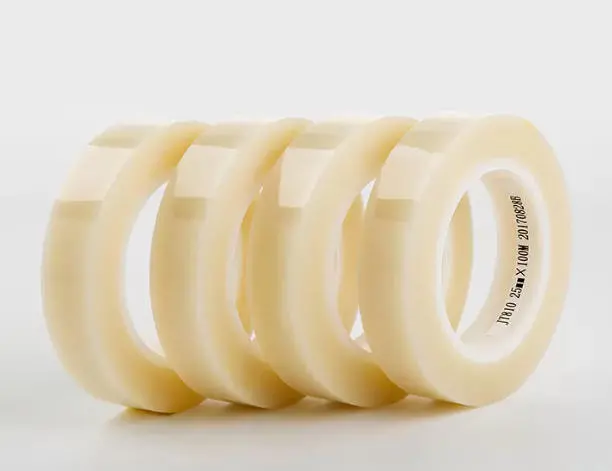
Polyester (PET) masking tape is used when the masking material needs to maintain its shape and provide a consistent edge during processing. Compared with crepe paper, PET film generally offers better dimensional stability and a smoother backing. These characteristics can be valuable when masking narrow areas, repeated patterns, or components that require controlled surface treatment.
PET masking tape is used in industrial painting, coating, precision masking, and selected high-temperature processes. Its performance depends on the entire construction, not just the polyester backing. Adhesive chemistry, tape thickness, backing treatment, and the target substrate all influence whether the tape stays in place and removes cleanly.
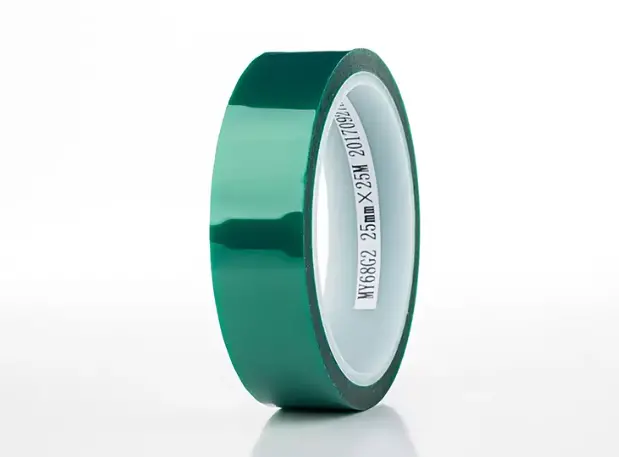
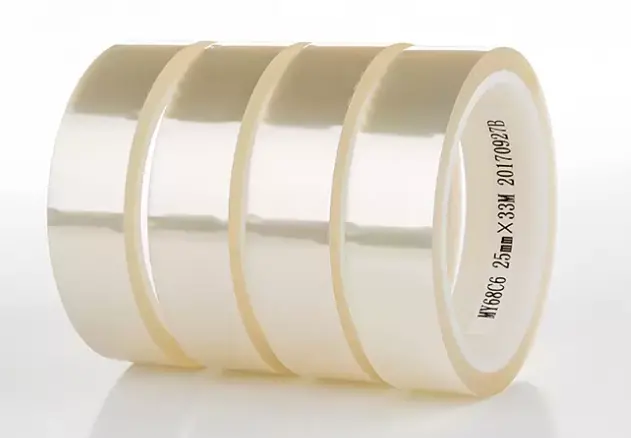
For example, Jantape's PET masking tape MY68G2 is designed for temporary masking, color separation, and surface protection in applications including high-temperature spraying and precision electronic soldering. The product's stated temperature rating applies to that specific tape and should not be treated as a universal limit for PET masking tapes.
PET film is not always the best choice for highly irregular surfaces. A relatively stiff film may be less able to follow tight curves or uneven contours than a conformable paper tape. If the edge needs to turn sharply around a component, test the tape for lifting and paint seepage before approving it for production.
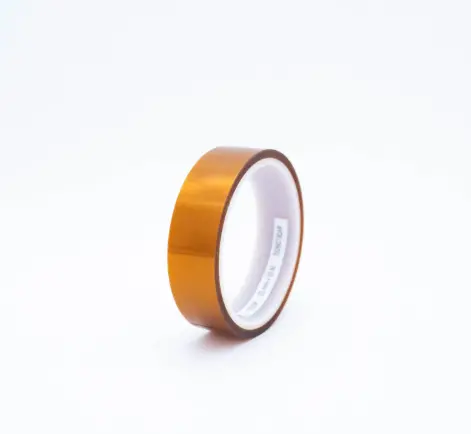
Polyimide masking tape is widely used in electronics manufacturing and other applications that require a thin, stable backing under elevated temperatures. It is often found in PCB assembly, soldering operations, electrical insulation, and processes where selected areas must remain protected during heating.
Its suitability comes from the combination of the polyimide film and the adhesive system. The backing alone does not determine the tape's maximum operating temperature, electrical properties, or removal performance. Two products made with polyimide film can behave differently when exposed to the same process.
For electronics manufacturers, the key question is not simply whether a tape is labeled heat-resistant. The tape must remain securely positioned during the required heating cycle, protect the intended area, and release without leaving adhesive on contacts, components, or finished surfaces. Where electrical insulation is part of the application, the relevant insulation specifications also need to be verified.
A few checks are especially important:
Confirm the maximum temperature and the permitted exposure time for the selected tape.
Check whether the tape is compatible with the substrate, soldering process, and any cleaning agents used afterward.
Verify removal behavior after heating, since a product that removes easily before processing may behave differently after thermal exposure.
Polyimide masking tape is often a strong candidate for heat-intensive electronics work, but the final choice should be based on the actual process conditions rather than the backing material alone.
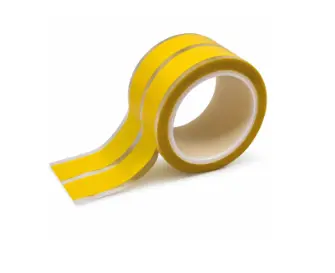
Fine line masking tape is designed to create sharp paint boundaries, including narrow stripes, curved contours, and multicolor finishes. It is commonly used in automotive refinishing, component painting, decorative coating, and applications where the appearance of the finished edge is important.
Unlike general masking tape, fine line tape is selected primarily for its ability to follow a defined path and maintain edge quality. A tape that adheres strongly to a flat panel may still lift at a tight curve, allowing paint to creep underneath. Excessive stiffness can also make it difficult to reproduce the same line consistently across multiple parts.
When comparing fine line masking tapes, consider:
Conformability: Can the tape follow the required curves without wrinkling or springing back?
Edge control: Does it prevent paint from bleeding beneath the tape under the actual application conditions?
Removal: Can it be removed at the correct stage without damaging the finish or leaving residue?
For complex shapes, application technique matters alongside tape selection. Stretching the tape excessively around a curve can create tension that encourages lifting. Applying it without wrinkles and pressing down the masking edge consistently helps produce a more reliable result.
Fine line tape is not a substitute for every type of masking tape. It is often used together with wider masking materials, which cover the surrounding area while the fine line tape defines the precise paint boundary.
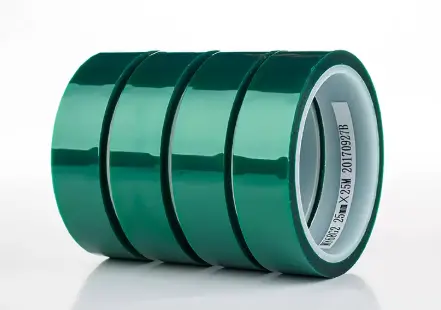
High-temperature masking tape is intended for processes where ordinary masking materials may soften, shrink, lose adhesion, or leave residue after heating. Applications include paint baking, selected coating operations, and manufacturing processes that expose components to elevated temperatures for a defined period.
"High-temperature" describes a performance requirement rather than a single backing material. Paper, PET, and polyimide tapes may all be developed for heat-related applications, but they do not have interchangeable performance limits. The adhesive formulation is particularly important because it must maintain sufficient holding power during processing and still permit clean removal afterward.
A temperature rating is useful only when it reflects the actual conditions of use. Peak temperature, dwell time, heating and cooling rates, and the number of cycles can all affect the result. A tape that withstands a brief exposure may not perform equally well during a longer bake or repeated heating cycles.
For production use, verify the following information before approving a tape:
The rated temperature and the corresponding exposure duration.
Whether the rating applies to a continuous exposure or a specific test condition.
The recommended removal temperature and any restrictions on reuse or repeated cycles.
The expected behavior on the actual substrate after the full heating process.
A controlled trial is particularly valuable when the part has a costly finish or when adhesive residue could interrupt a downstream operation.
The same tape may perform well in one process and fail in another. A useful starting point is to identify what the masking operation must prevent, how long the tape must remain in place, and what condition the surface must be in when the tape is removed.
During painting, masking tape separates coated and uncoated areas and protects surfaces that must remain untouched. Automotive refinishing may require clean color transitions, narrow decorative stripes, or masking around complex body contours. Industrial parts may instead need repeatable masking positions across large production batches.
The tape must resist lifting under the selected paint application conditions while preventing coating from reaching protected areas. For curved designs, conformability and edge control are especially important. For large flat surfaces, efficient application and reliable removal may carry more weight.
The right product also depends on the coating and drying process. Solvent exposure, paint build-up at the edge, drying time, and any subsequent heating can affect the result. A successful test should evaluate the finished paint edge and the removal process, not just whether the tape initially sticks.
Electronics processes may require masking during soldering, coating, or other heat-intensive operations. In these applications, tape selection can affect more than surface appearance: adhesive residue or a misplaced tape edge may interfere with electrical contacts, component assembly, or later processing.
Polyimide tape is commonly considered for high-temperature electronics work, while PET tapes may suit other precision masking tasks when their adhesive and thermal properties meet the process requirements. The appropriate choice depends on temperature exposure, insulation needs, component geometry, and the cleanliness required after removal.
Manufacturers should also consider whether the tape will be applied to bare materials, solder masks, coated surfaces, or delicate components. Adhesion that is adequate on one surface may be too aggressive or too weak on another.
Metal finishing operations may involve painting, coating, electroplating, or other treatments in which certain areas must remain unprocessed. The masking material needs to protect the intended surface without lifting or allowing treatment media to pass beneath the edge.
Chemical compatibility becomes important when the tape contacts process solutions, cleaning agents, or solvents. Dimensional stability and edge sealing may also matter when the protected area has tight tolerances. For masking tape for powder coating and electroplating, selection should account for the specific process conditions, since the two applications impose different requirements on temperature resistance, chemical compatibility, and edge protection.
The choice should be validated against the actual treatment cycle rather than based on a general claim that a tape is suitable for metal finishing.
| Industrial application | Main masking challenge | Properties to evaluate |
|---|---|---|
| General industrial painting | Protecting adjacent areas and maintaining the paint boundary | Adhesion, conformability, edge sealing, clean removal |
| Automotive two-tone painting | Reproducing narrow lines and curved contours | Fine-line definition, flexibility, resistance to lifting |
| High-temperature coating | Maintaining position through heating and cooling | Temperature rating, exposure time, adhesive stability, residue |
| Electronics and PCB processing | Protecting sensitive areas during thermal or assembly operations | Thermal performance, insulation requirements where applicable, adhesive cleanliness |
| Metal finishing and surface treatment | Preventing treatment media from reaching protected areas | Chemical compatibility, edge sealing, substrate adhesion, dimensional stability |
These are selection priorities rather than guarantees. The required combination of properties depends on the specific process, substrate, and tape construction.
A reliable selection starts with the manufacturing conditions, not the product name. Before requesting samples or comparing specifications, define the surface to be masked, the conditions the tape will experience, and the result required after removal.
Adhesion can change substantially between bare metal, painted metal, plastic, glass, and coated surfaces. Surface texture, contamination, release coatings, and the age of an existing finish can all influence how a tape performs.
A tape with high initial adhesion is not necessarily the best option. If the adhesive bonds too aggressively to a delicate coating, removal may cause lifting or damage. If adhesion is too low, the tape may move during spraying or allow material to seep underneath.
Test the tape on the actual substrate whenever possible. Include the surface preparation used in production, because a sample applied to a clean laboratory panel may not behave the same way on a production component.
For heated processes, record more than the maximum temperature. The tape may experience a rapid temperature rise, a sustained hold, cooling, or multiple cycles. Each stage can affect adhesion and residue.
Review the manufacturer's specified conditions and confirm whether the rating reflects the exposure duration and process method you intend to use. Do not assume that two tapes with the same stated maximum temperature will perform equally well in production.
The required masking result should determine how the tape is evaluated. General surface protection may allow a wider margin, while a visible paint boundary or a precisely defined treatment area requires more consistent edge control.
Removal also deserves attention early in the selection process. Consider when the tape will be removed, whether the part will be hot or cool, how long the adhesive will have remained on the surface, and whether the finish is sensitive to pulling or peeling. Residue-free removal should be verified under those conditions rather than assumed from a product description.
Before moving a tape into regular production, run a controlled test using the intended substrate, process settings, and removal method. Where possible, compare candidate tapes under the same conditions so the results are meaningful.
A practical validation checklist includes:
Masking quality: Check for paint bleed, edge gaps, wrinkles, and movement during processing.
Process resistance: Confirm that the tape remains intact and positioned correctly throughout the complete exposure.
Removal performance: Look for adhesive residue, tearing, surface damage, or lifting of the underlying coating.
Repeatability: Test more than one part and, where relevant, more than one tape roll or production batch.
Production fit: Consider application speed, handling difficulty, waste, and the time required to clean or rework defective parts.
The last point is easy to overlook. A lower-priced tape may cost more overall if operators need additional time to apply it, replace lifted sections, remove residue, or repair rejected finishes. For production buyers, the relevant comparison is the total cost of achieving an acceptable result, not just the price per roll.
Several recurring mistakes can cause masking failures even when a tape appears suitable on paper.
Choosing by maximum temperature alone. A temperature rating does not fully describe performance. Exposure time, adhesive stability, cooling conditions, and removal requirements also matter. A tape that survives the heat but leaves residue may still be unsuitable.
Using the same tape on every substrate. Adhesion and removal behavior vary with surface material and finish. A product that works well on steel may lift from a textured plastic surface or damage a softer coating during removal. Qualification should reflect the actual range of substrates used in production.
Checking adhesion but ignoring the finished result. Initial tack is only one part of masking performance. A tape may stick firmly yet allow paint to bleed under its edge, shrink during heating, or leave adhesive behind. Testing should cover the entire process, from application to final removal.
Overlooking application technique. Even a suitable tape can fail when applied to a dirty surface, stretched too tightly around a curve, or pressed down inconsistently. Clear work instructions and repeatable application methods help reduce variation between operators.
Assuming that all tapes with the same backing are equivalent. Backing material is an important starting point, but adhesive formulation, thickness, and construction also affect performance. Compare product-specific technical data and confirm the result in a process trial.
The best masking tape is the one that performs consistently under the conditions of the intended process. Crepe paper tape offers flexibility and convenience for many general painting tasks; PET masking tape can support more controlled masking where dimensional stability matters; and polyimide tape is frequently considered for heat-intensive electronics applications. Fine line and high-temperature tapes address specific performance needs that cannot be judged by backing material alone.
For industrial buyers, the most useful comparison is based on substrate compatibility, edge quality, temperature and chemical exposure, and removal behavior. Define those requirements first, then evaluate candidate tapes against the complete production cycle. This approach reduces the risk of coating defects, adhesive residue, unnecessary rework, and inconsistent results between batches.