 en
en vi
vi es
es th
th pt
pt ms
ms ko
ko ru
ru fr
fr de
de ar
ar hi
hi id
id





Oct 16,2026
What are Splicing Tapes and Why Do They Matter
In optical lens production, mold tape is easy to overlook because it is not part of the finished lens. Its role is temporary, but the way it behaves during that temporary period can affect positioning, surface protection, handling, and the amount of rework required later.
This matters particularly in resin lens manufacturing, where the tape may come into contact with curved surfaces and remain in place through specific processing conditions. A tape that holds well for a few minutes may not behave the same way after longer contact, exposure to heat, or removal from a particular lens surface.
The purpose of mold tapes for optical lens applications is therefore not simply to provide adhesion. The tape needs to perform a controlled job during production and then leave the process without creating another problem.
Optical lens manufacturing involves operations in which a component or surface may need to be temporarily held, protected, or separated from another part of the process. These temporary requirements are where mold tape becomes useful.
The important point is that the tape is working as part of the manufacturing process rather than as a permanent bonding material. It may need to hold a component in a fixed position during handling, maintain contact with a mold-related surface, or provide temporary protection before the next operation.
That creates a very different performance requirement from a general-purpose adhesive tape.
During the working stage, the tape needs enough adhesion to prevent unwanted movement. At the end of the operation, it needs to release in a controlled manner. If either side of that balance is wrong, the tape can become a source of production problems.
For example, insufficient adhesion can allow an edge to lift or a component to move. Excessive adhesion can increase removal force and create adhesive transfer. Neither outcome is desirable when the tape is being used on an optical component or a surface that requires controlled handling.
The role of optical lens mold tape depends on the manufacturing process, but three functions are particularly important: temporary fixation, controlled surface contact, and predictable removal.
During processing and handling, even a small amount of movement can affect the consistency of the next operation. Tape provides a temporary holding interface without requiring a permanent adhesive bond.
The required holding force depends on the actual application. A tape used on a relatively stable surface may have very different requirements from one exposed to repeated handling or mechanical stress.
This is why choosing tape solely according to a high adhesion value can be misleading. The relevant question is whether the tape maintains sufficient holding force throughout the process without becoming unnecessarily difficult to remove.
A mold-related application can also require the tape to maintain uniform contact with a surface. This becomes more difficult when the surface is curved or when the application follows a particular lens geometry.
If the tape does not conform properly, wrinkles or small gaps may appear. An edge can lift even though the center of the tape remains attached. Once this happens, the tape may no longer provide the intended level of protection or fixation.
For lens mold tape for optical manufacturing, conformability is therefore closely related to practical adhesion. A tape can have adequate adhesive strength on a test panel and still perform poorly if it cannot maintain contact with the actual production geometry.
The tape's job ends when the relevant manufacturing operation is complete, but removal is part of its performance.
Operators need to be able to remove the tape at the intended stage without excessive force, tearing, or adhesive transfer. If removal creates residue, the manufacturer may need an additional cleaning operation. In a high-volume process, even a small amount of additional handling can become significant over many production cycles.
The best result is not necessarily the easiest possible release. The tape first has to remain stable for as long as the process requires. The target is controlled release after sufficient holding, not weak adhesion from the beginning.
The surface receiving the tape has a direct influence on adhesive behavior. Resin lenses can differ in material composition, surface condition, geometry, and processing history, so the same tape may not produce identical results across every lens.
A useful evaluation therefore starts with the actual production substrate. Testing a tape on a generic plastic sheet can show whether the adhesive bonds to plastic, but it does not necessarily show how it will behave on a finished lens or mold surface.
Surface preparation can also change the result. Dust, oil, release agents, coatings, or other contaminants may reduce the effective contact between adhesive and substrate. When production conditions vary, apparent differences in tape performance may sometimes originate from surface preparation rather than from the tape itself.
This is particularly relevant when manufacturers work with several lens specifications. For example, a tape used with a standard resin lens should not automatically be assumed to perform identically when applied to another lens material or surface condition.
The same principle applies to 1.56 refractive index lens tape and other refractive-index-specific products. The refractive index itself does not determine adhesive performance, but differences in lens material and manufacturing conditions associated with different lens specifications can affect which tape construction is appropriate.
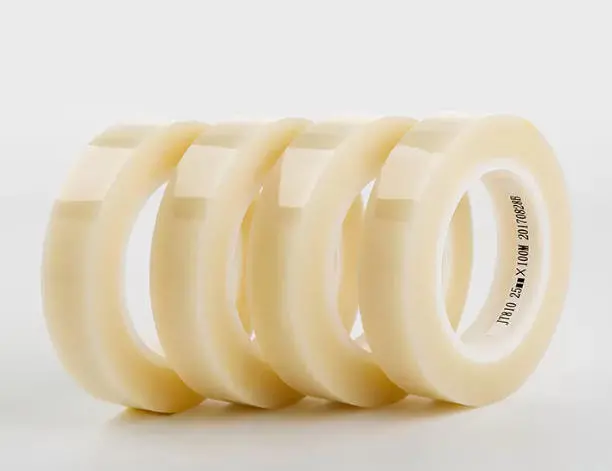
Optical lenses are not simple flat substrates. Curvature changes the way a tape is applied and how forces are distributed across the adhesive interface.
On a curved surface, the tape may experience different levels of tension near the edges than in the center. If the tape is too rigid or does not conform well enough, the edges may gradually lift. If application pressure is inconsistent, parts of the tape may also have less effective contact with the substrate.
For this reason, production testing should reproduce the actual application geometry wherever possible.
Several observations are particularly useful during a trial:
Whether the tape follows the lens surface without wrinkling
Whether the edges remain attached during handling
Whether the tape changes shape during processing
Whether removal force is consistent across the entire applied area
These practical observations often reveal problems that cannot be identified from a standard peel-strength figure alone.
For mold tape applications, stronger adhesion is not automatically better.
Consider two possible failures. If adhesion is too low, the tape may move or lift during processing. If adhesion is too high, the tape may become difficult to remove or leave adhesive on the surface. Both problems can interrupt production, even though they occur at opposite ends of the adhesion range.
| Tape behavior | Production effect |
|---|---|
| Low adhesion | Movement, lifting, or loss of temporary fixation |
| Stable adhesion | Consistent holding during the required process |
| Excessive adhesion | Higher removal force and potential residue |
| Unstable adhesion | Different performance before and after processing |
The useful target is a stable adhesive interface that survives the required process and releases when the tape is no longer needed.
This becomes particularly important when the tape remains in place for an extended period. Adhesive behavior can change with time, temperature, pressure, and contact with the substrate. A sample that performs well immediately after application may therefore give a different result after the actual production cycle.
Temperature is another reason laboratory testing and production performance do not always match.
Heat can alter adhesive characteristics, while longer dwell time can change the force required for removal. If a tape is exposed to elevated temperature during processing, it should be tested under that condition rather than evaluated only at room temperature.
The same applies to contact time. A tape that removes cleanly after a short test may behave differently after remaining on the surface for several hours.
A practical qualification test should therefore reproduce the important variables of the production process:
Apply the tape to the actual lens or mold surface using the intended application method.
Keep it in place for the expected processing time.
Expose it to the expected temperature and handling conditions.
Remove it using the same method operators will use in production.
Inspect both the tape and the surface after removal.
The final inspection should include more than visual appearance. Any change in removal force, adhesive transfer, edge lifting, or surface condition can be relevant to process stability.
For manufacturers, tape qualification is more useful when every test result can be connected to a production requirement.
| Property | What it affects in production |
|---|---|
| Adhesion stability | Whether the tape stays in position |
| Conformability | Whether the tape maintains contact on curved surfaces |
| Release behavior | How consistently the tape can be removed |
| Residue performance | Whether additional cleaning is required |
| Temperature resistance | Whether performance changes during heat exposure |
| Thickness consistency | Whether application remains uniform |
| Dimensional stability | Whether the tape deforms during processing |
Thickness and dimensional consistency may seem less important than adhesion, but they become more noticeable in repetitive manufacturing. If the tape is converted into specific widths, shapes, or die-cut components, variation can affect application accuracy and handling.
The supplier's converting capability can therefore be relevant when the tape will be used at production scale. Consistent slitting, winding, and die-cutting can help reduce variation between production batches.
A tape should ideally be approved using the same material, geometry, process temperature, dwell time, and removal method used in production.
This is especially important when several types of optical lenses are manufactured on the same site. A tape may perform well on one lens specification and require adjustment on another because of differences in surface condition or geometry.
A simple qualification matrix can help identify whether one tape is suitable across multiple applications or whether separate specifications are needed.
For example:
| Test condition | Sample A | Sample B | Sample C |
|---|---|---|---|
| Initial adhesion | Check | Check | Check |
| Adhesion after processing | Check | Check | Check |
| Edge stability | Check | Check | Check |
| Removal force | Check | Check | Check |
| Residue | Check | Check | Check |
| Surface condition after removal | Check | Check | Check |
The purpose is not to generate the largest possible amount of test data. It is to identify whether the tape behaves consistently under the conditions that matter to the production line.
Mold tape is only one part of the tape requirements encountered in optical lens production. Different manufacturing operations can require different adhesive constructions and performance characteristics.
Jantape's Optical Lenses range covers tape solutions for different optical lens applications, allowing manufacturers to evaluate products according to the specific process rather than treating every lens application as the same.
For mold-related applications, the important distinction is that the tape is being used as a temporary process material. Its value comes from how reliably it performs during the period when the lens or mold needs protection, fixation, or controlled contact.
The most reliable starting point for selecting mold tapes for optical lens production is the manufacturing process itself.
Instead of asking only which tape has the highest adhesion, manufacturers should define the conditions the tape must survive and the condition in which it must be removed. Lens material, surface preparation, geometry, processing temperature, dwell time, mechanical handling, and acceptable residue levels all form part of the specification.
When these factors are clearly defined, tape selection becomes much more practical. A supplier can evaluate the adhesive system against the actual application rather than recommending a general-purpose product based on limited information.
For applications that require a closer match between tape construction and production conditions, Mold Tapes for Optical Lens provides a more relevant starting point than a general industrial adhesive category.
The objective is straightforward: the tape should stay where it is needed, remain stable for the required part of the process, conform to the intended surface, and leave the production line cleanly when its job is finished.