 en
en vi
vi es
es th
th pt
pt ms
ms ko
ko ru
ru fr
fr de
de ar
ar hi
hi id
id





Sep 24,2026
Custom Lens Mold Tape for Optical Lens Production
Optical lens production does not place the same demands on mold tape from start to finish. The tape may need to conform to a mold surface during application, maintain positioning during resin filling, withstand the curing cycle, and then release cleanly during demolding. A lens mold tape that performs well at one stage can still create problems at another if its adhesion, backing, temperature resistance, or removal behavior does not match the actual process.
For manufacturers, the important question is therefore not simply whether a tape sticks to the mold. The better question is whether it maintains the required performance throughout the complete optical lens manufacturing cycle.
In a typical resin lens molding process, mold tape can be exposed to several different conditions within a relatively short period. Application requires good handling and contact. Mold assembly requires stable fixation and sealing. Resin filling can introduce pressure and movement. Curing exposes the adhesive and backing to heat and chemical conditions, while demolding changes the requirement from holding strength to controlled release.
The function of the tape changes as the process moves forward:
Manufacturing stage | Main tape function | Typical production concern |
Mold preparation | Establish stable contact with the mold | Poor contact, wrinkles, contamination |
Mold assembly | Fix and seal the mold components | Edge lifting or mold movement |
Resin filling | Maintain the intended mold configuration | Resin leakage or displacement |
Curing | Remain stable throughout the curing cycle | Adhesive change, deformation, residue |
Demolding | Allow controlled separation | Excessive peel force or tearing |
Tape removal | Leave the mold in an acceptable condition | Adhesive transfer or cleaning burden |
This is why a single specification such as peel adhesion cannot fully describe whether a tape is suitable for lens molding. The tape has to work as part of the process rather than as an isolated consumable.
The first stage determines how consistently the tape will perform later. Before adhesive performance can be evaluated, the tape must make uniform contact with the intended mold surface.
Dust, oil, release-agent residues, moisture, or previous adhesive deposits can change the actual contact between the tape and mold. Two molds made from the same material can therefore produce different results if their surface preparation differs.
This becomes particularly important when production uses repeated mold cycles. If cleaning gradually changes the surface energy or leaves small amounts of previous adhesive behind, the same lens mold tape may show different holding behavior from one cycle to the next.
For production validation, the following should be controlled:
· Mold material and surface finish
· Cleaning method and drying condition
· Presence of release agents or other surface treatments
· Application pressure and application speed
· Time between tape application and the next manufacturing step
The objective is not to maximize adhesion at this stage. It is to establish consistent contact over the required area without wrinkles, lifting, or trapped contamination.
Optical lens molds are not always simple flat surfaces. Curved geometries and narrow edges can make it difficult for a tape to maintain uniform contact.
A backing that is too stiff may bridge across a curved area instead of following the mold contour. Excessive stiffness can create local stress at the tape edge, while insufficient dimensional stability can allow the tape to deform during later processing.
For this reason, lens mold tape for optical lens manufacturing needs to balance flexibility with dimensional stability. The appropriate balance depends on the mold geometry, contact area, tape thickness, and application method.
Once the tape has been applied, its role becomes more mechanical. It may help hold mold components in their intended relationship while the lens material is introduced and before curing begins.
A tape can show strong initial adhesion and still be unsuitable for production if its holding performance changes after exposure to temperature, pressure, time, or resin-related conditions.
In mold assembly, excessive movement can alter the intended cavity geometry. Even a small displacement may affect lens thickness, edge dimensions, or the consistency of the finished part.
This is one reason initial tack should not be treated as a complete measure of lens mold tape performance. The more useful production question is whether the tape maintains stable fixation for the required period.
The relationship can be viewed as:
Application → positioning → resin filling → curing → demolding
A tape that performs well only during the first step has limited value if it loses stability before curing is complete.
During resin filling, the tape can contribute to maintaining the mold assembly and sealing interfaces. If an edge lifts or the tape shifts, resin may enter an unintended area or the mold geometry may change.
Plastic lens molding patents describe processes in which adhesive tape is used around mold components before resin injection, followed by heat or light curing and subsequent tape removal. These processes illustrate why tape behavior needs to be considered as part of the complete molding sequence rather than evaluated only during application. Google Patents — Plastic Lens Molding Adhesive Tape
For production engineers, useful checks at this stage include:
· Whether the tape remains in its original position after resin filling
· Whether sealing edges remain intact
· Whether the mold components maintain the intended alignment
· Whether resin reaches areas that should remain free of adhesive
Curing is often where a tape that looked acceptable during application begins to show its limitations. The adhesive system and backing are now exposed to the actual thermal and chemical conditions of lens production.
Temperature resistance should not be interpreted simply as the highest temperature a tape can theoretically tolerate.
A production process has a temperature profile rather than a single temperature value. The relevant factors may include:
· Peak temperature
· Heating rate
· Holding time
· Cooling rate
· Number of heating cycles
· Contact with resin or other process materials
A tape that survives a short exposure at a given temperature may behave differently during a longer curing cycle. Adhesive flow, softening, shrinkage, backing deformation, and changes in peel behavior can all affect the result.
For this reason, lens mold tape for curing processes should be evaluated under the actual or representative production cycle whenever possible.
Temperature is only one part of the curing environment. Resin chemistry can also influence tape performance.
Different resin systems may have different compositions, curing mechanisms, additives, and reaction conditions. A tape that has been successfully qualified with one resin formulation should not automatically be assumed to perform identically with another.
This is particularly relevant for high-index resin lenses, where the formulation and processing conditions can impose different requirements on the tape. Specialized tape selection may therefore be necessary when the resin system changes. The production implications of these materials are discussed in more detail in why high-index lenses need specialized mold tape.
The useful validation question is not simply:
Can the tape withstand the curing temperature?
It is:
Does the tape maintain its required adhesion, dimensional stability, sealing performance, and removability throughout the complete curing cycle?
After curing, the performance requirement changes again. The tape must now release from the mold without creating excessive force, tearing, adhesive transfer, or unnecessary cleaning work.
The force required to remove tape can change substantially after processing. Heat exposure, aging during the curing cycle, contact with resin components, and changes in the adhesive layer can all affect the final peel behavior.
For this reason, lens mold tape removal should be evaluated after the actual production process rather than only with an unused tape sample.
Peel adhesion is a useful standardized measurement, and ISO 29862:2024 provides methods for determining peel adhesion properties of self-adhesive tapes. However, a standardized peel value is only one part of a production evaluation.
ASTM D3330 makes a similar distinction: peel adhesion can be measured under controlled conditions, but the measured value may not directly represent the functional requirement of a particular application. ASTM D3330/D3330M is therefore useful as a test reference, but production validation still needs to reproduce the actual application conditions.
A tape can remove easily and still be a poor production choice if it leaves adhesive residue on the mold.
Lens mold tape residue can create several downstream problems. Operators may need additional cleaning, mold preparation time can increase, and residual adhesive can affect subsequent tape application or mold surface condition.
The practical evaluation should therefore consider more than peel force:
Removal criterion | What to check |
Peel force | Is removal controlled and manageable? |
Adhesive transfer | Does adhesive remain on the mold? |
Tape integrity | Does the tape remove as one piece? |
Mold condition | Is the mold surface clean enough for reuse? |
Cleaning time | Is additional cleaning required? |
Repeatability | Does the result remain consistent across cycles? |
In other words, clean removal is a production requirement, not simply a cosmetic advantage.
A useful qualification program follows the actual production sequence instead of testing the tape in isolation.
Stage | What to validate | Useful production evidence |
Application | Contact and conformability | Uniform placement, no wrinkles or lifting |
Assembly | Holding stability | No mold movement or edge lifting |
Resin filling | Sealing and positioning | No leakage or dimensional displacement |
Curing | Thermal and process stability | No unexpected lifting, deformation, or adhesive change |
Demolding | Release behavior | Controlled peeling without tearing |
Removal | Surface cleanliness | Low residue and acceptable cleaning time |
This approach gives engineers a much clearer picture of lens mold tape performance than relying on one specification from a supplier datasheet.
Peel strength is easy to compare because it produces a numerical result. But optical lens production involves several performance dimensions that a single peel value cannot capture.
Consider two tapes with similar peel adhesion. One may maintain stable contact during a long curing cycle and remove cleanly afterward. The other may soften during heating, shift during resin filling, or leave adhesive residue after curing.
The difference is not necessarily visible in the initial peel test.
A more complete evaluation considers:
Adhesion + temperature exposure + mold surface + resin compatibility + dimensional stability + removal behavior
This is particularly important when changing suppliers or replacing an existing tape. A tape should not be approved solely because its datasheet value appears close to the existing product.
Before introducing a new optical lens molding tape, testing should reproduce the conditions that create the actual production risk.
Whenever possible, use the same mold material, surface finish, cleaning method, and application procedure used in production. Testing only on stainless steel or another standardized surface can provide useful comparative data, but it does not reproduce the complete mold interface.
The test should reflect the production temperature profile and exposure time. If the process uses staged heating or cooling, those stages should be included.
The tape should be inspected both during and after the cycle for:
· Edge lifting
· Shrinkage or deformation
· Adhesive flow
· Wrinkling
· Loss of holding stability
· Changes in removal behavior
After curing and demolding, inspect both sides of the interface. Looking only at the removed tape can miss adhesive transfer or surface contamination on the mold.
A practical inspection should record whether:
· The mold surface remains clean
· Adhesive remains on the mold
· The tape backing has changed
· Removal requires abnormal force
· The mold needs additional cleaning
One successful trial does not necessarily establish process consistency. Repeating the test with multiple tape lots and production cycles helps determine whether the performance is stable enough for regular manufacturing.
This is especially important when the tape is used in high-volume production, where a small failure rate can become a significant source of scrap, rework, or cleaning downtime.
There is no need to select a completely different tape for every individual operation if one product can reliably cover the entire process. The key is to identify the most demanding stage and make sure the tape remains functional from application through removal.
A practical selection process starts with these questions:
1. What surface does the tape contact?
Identify the mold material, surface finish, curvature, and any surface treatment.
2. What does the tape experience during molding?
Define the resin system, temperature profile, curing time, pressure, and other relevant process conditions.
3. What must happen during demolding?
Determine whether controlled peel, clean removal, low residue, or rapid removal is particularly important.
4. What happens after the tape is removed?
Consider mold reuse, cleaning requirements, inspection, and the next production cycle.
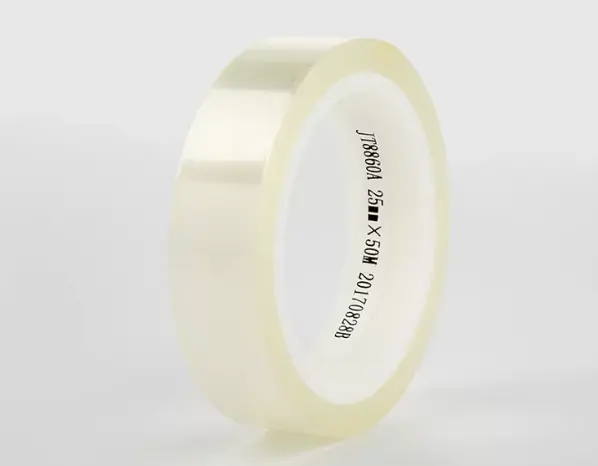
For applications involving different optical lens materials, mold geometries, or curing conditions, the requirements can vary considerably. The broader mold tapes for optical lens range should therefore be considered in relation to the actual process rather than selected only by tape thickness or nominal adhesion.
Standard products are often sufficient when the mold geometry and process conditions fall within an established operating range. Customization becomes more relevant when a production line has a combination of conditions that cannot be reliably covered by an existing specification.
Typical reasons for considering a customized lens mold tape include:
· Unusual mold curvature or narrow contact areas
· A demanding curing temperature or extended thermal cycle
· A new resin formulation with different chemical behavior
· Very strict residue requirements
· Special tape thickness or width requirements
· Automated application or removal processes
· A need to balance holding force with easier demolding
Customization should still be treated as an engineering qualification process rather than simply a request for a different adhesive strength. Backing material, thickness, adhesive formulation, release behavior, dimensional stability, and converting requirements may all influence the final result.
The most useful specification is ultimately the one that remains stable across the complete optical lens manufacturing process: easy enough to apply, stable enough to hold, resistant enough to survive curing, and controlled enough to remove without creating additional production work.