 en
 vi
 es
 th
 pt
 ms
 ko
 ru
 fr
 de
 ar
 hi
 id





Nov 13,2026
Acrylic vs Rubber Adhesive Tape Which Performs Better
Choosing between acrylic and rubber adhesive tape is not simply a matter of deciding which one sticks more strongly. A tape that grabs a surface quickly may be useful on an assembly line, but that same product may not be the best choice for a component expected to remain bonded for years. Likewise, an adhesive with good long-term stability is not automatically suitable for every substrate or production process.
The difference becomes clearer when you look at how the tape will be used. Initial tack, peel adhesion, holding power, temperature exposure and the condition of the bonding surface all affect the result. Acrylic and rubber-based adhesives each have advantages, but those advantages matter in different situations.
Both acrylic and rubber adhesives are widely used in pressure-sensitive tapes. They form a bond when pressure brings the adhesive into close contact with a surface, without requiring a separate curing step. Their chemical composition, however, gives them different performance characteristics.
Acrylic adhesive is often selected when long-term bonding stability and resistance to environmental exposure are important. Acrylic formulations can be adjusted for different levels of tack, peel adhesion and flexibility. They are commonly used in industrial tapes for electronics, mounting, surface protection and other applications where consistent performance over time matters.
Rubber-based adhesive is frequently chosen for applications that need a quick initial grab. Depending on the formulation, it can wet out a surface readily and provide useful adhesion during fast assembly or general-purpose fixing. Natural rubber and synthetic rubber adhesives are not identical, so their temperature resistance, aging behavior and compatibility with different materials can vary.
| Comparison point | Acrylic adhesive | Rubber-based adhesive |
|---|---|---|
| Initial tack | Formulation-dependent; can range from moderate to high | Often designed to provide quick initial grab |
| Long-term stability | Generally offers good aging stability | Depends on rubber type and formulation |
| UV and weather exposure | Often better suited to prolonged exposure | May require more careful evaluation |
| Temperature performance | Depends on the adhesive formulation and tape construction | Also varies with formulation and service conditions |
| Substrate compatibility | Available in formulations for a range of surfaces | Can provide good initial bonding on selected surfaces |
| Common selection priority | Durable, stable bonding | Fast adhesion and application-specific tack |
These are general tendencies, not guaranteed results for every product. A high-performance rubber adhesive may outperform a poorly matched acrylic tape, while a specially formulated acrylic adhesive can provide strong initial tack as well as long-term stability.
The adhesive is only one part of a finished tape, but it has a direct influence on how the product behaves after application. Three performance measurements are particularly important when comparing products.
Initial tack describes how readily an adhesive forms a bond when it first contacts a surface. It matters when operators need to position and secure a component quickly, especially in manual assembly or continuous production.
Rubber-based formulations are often associated with high initial tack. This can be useful when a tape needs to hold a part in position shortly after application. However, a strong initial grab does not necessarily mean the bond will remain stable under prolonged loading or elevated temperatures.
Acrylic adhesives can also be formulated for fast bonding. The actual result depends on the adhesive design, coating weight, surface condition and pressure applied during installation.
For production teams, the practical question is not simply whether a tape feels sticky. It is whether the tape develops enough adhesion within the available application time to prevent movement, lifting or misalignment.
Peel adhesion measures the force required to remove a tape from a surface at a specified angle and speed. Holding power, often assessed through a shear test, measures how well the adhesive resists movement under a sustained load.
These measurements describe different failure conditions. A tape may have a high peel value but still creep when a component places a constant load on it. Conversely, a tape designed to resist shear movement may not be especially difficult to peel away.
For applications involving vertical mounting, component retention or prolonged mechanical stress, holding power deserves particular attention. For bonding applications where an edge may be lifted or pulled, peel adhesion may be more relevant.
When reviewing a technical data sheet, check:
Initial tack to understand how quickly the tape establishes contact.
180° peel adhesion to assess the force required for removal under the stated test conditions.
Holding power or shear resistance to understand how the bond behaves under sustained loading.
Do not compare figures from different suppliers without checking the test method, substrate, dwell time and temperature. A number without its testing conditions tells only part of the story.
Temperature affects pressure-sensitive adhesives in more than one way. At elevated temperatures, an adhesive may soften and become more prone to movement, edge lifting or adhesive transfer. At low temperatures, some formulations become less flexible and may struggle to wet out the bonding surface.
Long-term exposure introduces another consideration. Heat, oxygen, UV radiation and moisture can gradually change an adhesive's properties. The extent of this change depends on the formulation and the environment.
Acrylic adhesives are generally a strong option when resistance to aging and outdoor exposure is important. Some rubber-based adhesives, particularly those not designed for demanding environmental conditions, may experience a greater change in performance over time. This does not mean rubber adhesive tapes are unsuitable for long-term use; the specific product must be evaluated against its intended service conditions.
Pay close attention to the difference between a short-term temperature test and a continuous operating temperature. A specification such as 80°C for 30 minutes does not establish that a tape can remain bonded at 80°C indefinitely.
The best starting point depends on the job the tape needs to perform. Looking at the application first is more useful than choosing an adhesive based on a general performance ranking.
Acrylic adhesive tape is often worth evaluating for assemblies exposed to changing temperatures, light or outdoor conditions. It is also used in applications where a bond needs to remain stable over an extended service period.
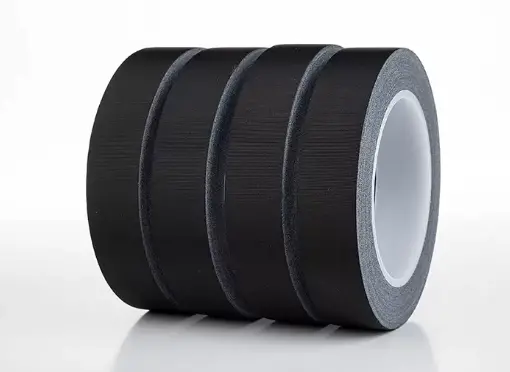
For electronic assemblies, the adhesive must work with the carrier material and the component surface. A thin PET-backed tape, for example, offers a different construction from a flexible cloth tape. The carrier affects dimensional stability, conformability and the thickness of the finished bond line.
The adhesive should therefore be selected alongside the backing material, rather than treated as an independent specification.
Rubber-based adhesive tape can be a practical option when fast contact and immediate positioning are important. It may suit assembly tasks where operators need the tape to hold a part in place without a long waiting period.
One example in Jantape's range is AC22X acetate cloth tape. Its product specifications identify a rubber adhesive and an acetate fabric backing. The listed initial tack is 10 N/25 mm, holding power is at least 24 hours, and the temperature resistance is rated at 80°C for 30 minutes. The tape is also specified for electrical applications, with a voltage resistance of at least 1.8 kV.
These figures describe AC22X under its stated test conditions. They should not be used as a general performance benchmark for all rubber adhesive tapes. The example is useful because it shows how adhesive type, fabric backing and electrical requirements come together in a finished product.
Some manufacturing processes need a tape to hold securely during production but come off cleanly when the work is complete. Flexographic plate mounting, masking and temporary component positioning are examples where removal behavior can be as important as bonding strength.
Neither acrylic nor rubber adhesive guarantees residue-free removal. The result depends on the adhesive formulation, backing, substrate, temperature, bonding time and removal method.
If the tape will be removed after heat exposure or an extended dwell period, test it under those same conditions. A product that removes cleanly after a short trial may behave differently after several hours or days.
A useful tape evaluation should reproduce the conditions the product will face in production. Testing only on a clean metal panel at room temperature may not reveal problems that occur on the actual component.
Start with these checks:
Identify the bonding surfaces. Record the substrate materials, surface finish and any coatings. Plastics such as PP and PE can be difficult to bond because of their low surface energy, so a dedicated adhesive formulation or surface treatment may be necessary.
Reproduce the application process. Use the intended application pressure, bonding time and installation temperature. If the tape is applied by machine, test it using the same equipment and line speed.
Test the bond after exposure. Measure peel adhesion and holding performance after the relevant heat, humidity or aging conditions. If removal is part of the process, inspect for residue and surface damage as well.
A side-by-side comparison is meaningful only when the test conditions are controlled. Use the same substrate, application pressure, dwell time and test temperature for both candidates. Otherwise, the results may reflect differences in the test setup rather than the adhesive systems.
It is also worth asking the tape supplier for the full technical data sheet. Confirm the backing material, adhesive type, total thickness, test standard and temperature conditions. If a product will be used in a safety-critical or regulated application, verify the relevant electrical, flame-retardant or other compliance requirements separately.
Acrylic adhesive is often the better starting point when long-term stability, aging resistance and environmental exposure are major concerns. Rubber-based adhesive is worth considering when fast initial grab and application-specific tack are more important.
Neither option should be selected on adhesive chemistry alone. A tape's backing, coating weight, thickness, bonding surface and processing conditions all contribute to its performance. The right choice is the one that meets the actual requirements of the assembly, not necessarily the one with the highest value on a single test.
Jantape supplies industrial tapes for fixing, electrical insulation, electronics, printing and other manufacturing applications. Its Fixing Tapes range includes products with different backing materials and adhesive specifications. For a closer look at how tape constructions are used across manufacturing, see the guide to different types of industrial adhesive tape.
When requesting a recommendation, provide the substrate materials, application method, operating temperature, required bonding time and removal conditions. These details give the technical team a much better basis for matching the adhesive system and tape construction to the job.
Not in every situation. Strength can refer to initial tack, peel adhesion or holding power, and these measurements do not describe the same property. The better-performing tape depends on the substrate, adhesive formulation and test conditions.
Acrylic adhesives generally offer better resistance to UV exposure and aging than many conventional rubber-based formulations. However, outdoor service life also depends on the backing material, moisture exposure, temperature changes and the specific adhesive design.
Yes, provided the complete tape construction meets the electrical and safety requirements of the application. The backing, adhesive, dielectric properties, flame-retardant performance and operating temperature should all be checked against the relevant specifications.
No. Peel adhesion is useful for evaluating resistance to removal, but it does not show how well a tape will resist sustained loading or movement. For component fixing, review holding power or shear performance as well, and test the tape on the actual substrate.