 en
 vi
 es
 th
 pt
 ms
 ko
 ru
 fr
 de
 ar
 hi
 id





Nov 20,2026
How to Choose Adhesive Tape for Plastic and Metal Surfaces
Bonding plastic to metal sounds straightforward until the assembly begins to fail. A tape that holds firmly on a stainless steel panel may lift from a polypropylene housing, while a product that bonds well to ABS may struggle on an oily aluminum component. The difference is not necessarily the tape's overall quality. It often comes down to how the adhesive interacts with each surface.
When choosing adhesive tape for plastic and metal surfaces, engineers need to consider both substrates rather than treating the joint as a single bonding surface. Metal and plastic differ in surface energy, texture, chemical composition and dimensional behavior. These factors influence initial tack, long-term adhesion and resistance to edge lifting.
For applications joining a plastic component to a metal part, a double-sided adhesive tape can provide a clean bonding line without screws, clips or liquid adhesive. However, the backing and adhesive must suit the actual materials. For example, Jantape's DS05C26 flame-retardant double-sided PET tape is specified for adhesion to stainless steel and PET surfaces. PET is a polyester plastic, so this provides a relevant example of a metal-to-plastic bonding combination. It should not be taken as proof of compatibility with every plastic resin.
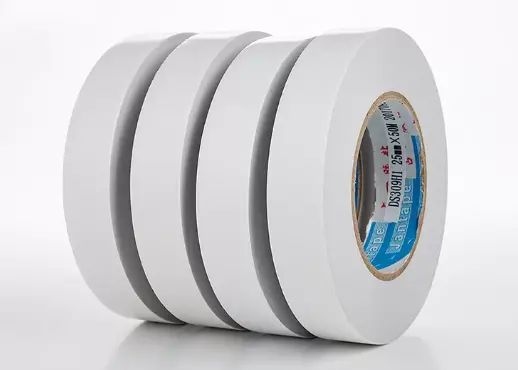
The material name alone is not enough to predict bonding performance. A bare aluminum sheet, powder-coated steel panel and anodized aluminum component may all require different testing. The same applies to plastics: ABS, PVC, PET, polycarbonate, polypropylene and polyethylene do not present identical bonding conditions.
Many metals have relatively high surface energy, which generally allows pressure-sensitive adhesives to spread and make contact more readily. Yet this does not mean every metal surface is easy to bond.
Machining oils, fingerprints, oxidation, polishing compounds and protective coatings can interfere with adhesive contact. Even when the metal itself is suitable, a contaminated or uneven surface may cause inconsistent results.
Before selecting tape for metal bonding, identify the actual surface condition:
Bare metal: Check for oil, dust, oxidation and residues from machining or handling.
Painted or powder-coated metal: Adhesion depends on the coating formulation, curing condition and surface texture, not simply the underlying steel or aluminum.
Anodized aluminum: The anodized layer creates a different bonding surface from untreated aluminum. Test the actual finish.
Brushed or textured metal: Surface irregularities may reduce the effective contact area, making adhesive thickness and conformability more important.
A tape tested on clean stainless steel may not perform the same way on a coated aluminum enclosure. Qualification should use production parts with the same finish and cleaning process.
Plastic materials vary considerably in their ability to accept pressure-sensitive adhesives. ABS, PVC and PET are often easier to bond than low-surface-energy materials such as polypropylene (PP) and polyethylene (PE), although the exact result depends on the resin grade, additives, texture and surface treatment.
Mold-release agents are a frequent source of bonding problems. They can remain on injection-molded components even when the surface looks clean. Plasticizers, slip agents and other additives may also migrate to the surface over time, affecting adhesion after assembly.
| Substrate | Typical bonding consideration | What to verify |
|---|---|---|
| ABS | Often suitable for general-purpose pressure-sensitive bonding | Surface texture, mold-release residue and actual resin grade |
| PET | Commonly used with film-based tape constructions | Surface cleanliness and compatibility with the adhesive |
| PVC | Formulation and plasticizer content can affect long-term adhesion | Adhesive compatibility and possible plasticizer migration |
| Polycarbonate (PC) | Surface condition and stress sensitivity need attention | Adhesive compatibility, stress cracking risk and temperature exposure |
| Polypropylene (PP) | Low surface energy can make direct bonding difficult | Whether surface treatment or a specialized adhesive is required |
| Polyethylene (PE) | Low surface energy and flexibility can complicate bonding | Surface treatment, deformation and sustained load |
For low-surface-energy plastics, a standard acrylic tape should not be assumed to provide reliable adhesion without testing. Some applications may require a specialized adhesive, corona or plasma treatment, or a suitable primer. The correct approach depends on the plastic formulation and the manufacturer's process.
The backing material provides dimensional support, but the adhesive is responsible for making contact with the surfaces. When one side of a joint is metal and the other is plastic, the adhesive must accommodate the different bonding characteristics of both materials.
Acrylic pressure-sensitive adhesives are widely used in industrial double-sided tapes because they can offer a useful balance of adhesion, aging resistance and environmental durability. Depending on the formulation, they may work across a range of metals, plastics and coated surfaces.
However, "acrylic" is not a guarantee of universal compatibility. Different acrylic formulations can have very different initial tack, peel adhesion, shear resistance and performance on low-energy plastics. A product that performs well on stainless steel may still need additional validation on PP or PE.
Rubber-based adhesive systems can provide high initial tack and fast bonding in applications where immediate handling strength is important. They may be suitable for certain plastic and metal assemblies, but their resistance to heat, UV exposure, oxidation and aging varies by formulation.
If the bonded component will operate outdoors, near a heat source or under sustained mechanical stress, evaluate the tape's long-term performance rather than choosing solely on initial adhesion.
Silicone adhesive tapes are worth considering where elevated temperatures or specialized surface requirements are involved. They are not automatically the best choice for ordinary plastic-to-metal assembly, however. Adhesion, cost, substrate compatibility and the required temperature profile all need to be assessed together.
The useful comparison is not simply acrylic versus rubber versus silicone. It is whether a particular adhesive formulation can maintain the required bond on both materials throughout the product's service life.
Once the adhesive system has been narrowed down, the tape construction becomes the next consideration. A thin PET-backed tape, a foam tape and a transfer adhesive may all create a bond, but they behave differently when the surfaces are uneven or exposed to movement.
PET-backed double-sided tape is suitable for assemblies that require a relatively thin bond line and dimensional stability. The film carrier helps maintain a consistent tape thickness and can make die-cutting and positioning easier.
Jantape's DS05C26 is one example: it uses a PET film backing, has a stated total thickness of 0.055 ± 0.005 mm and is specified for bonding to stainless steel and PET surfaces. Its product information also lists a VTM-0 flame-retardant rating. These specifications make it relevant to applications where a thin construction and flame-retardant performance are required, but the complete assembly still needs to be qualified for its intended use.
Foam-based double-sided tapes can accommodate small surface irregularities and help maintain contact where two parts are not perfectly flat. Their compressibility may also help distribute stress across the bonded area.
This can be useful when attaching plastic covers, trims or housings to metal structures. The trade-off is a thicker bond line, which may affect component positioning, dimensional tolerances and appearance.
Transfer tape consists of an adhesive layer carried on a release liner, without a separate film or foam backing. It can be useful when a very thin adhesive layer is required and the substrates provide sufficient support.
For a closer look at the construction differences, see Jantape's explanation of double-sided tape vs. transfer tape.
| Tape construction | Main advantage | Considerations for plastic-to-metal bonding |
|---|---|---|
| PET-backed double-sided tape | Thin, dimensionally stable bond line | Both surfaces need adequate contact; limited ability to fill gaps |
| Foam double-sided tape | Conforms to minor surface irregularities | Thickness, compression and long-term creep need evaluation |
| Transfer tape | Very thin adhesive layer | Requires suitable surface contact and support from the substrates |
Even a suitable tape can fail when application conditions are inconsistent. Dust, oil and cleaning residues prevent the adhesive from making full contact with the substrate. Insufficient pressure can leave small gaps, while applying tape to a cold or damp surface may affect bonding development.
A practical application procedure should include:
Clean both surfaces: Use a cleaning method compatible with the metal finish and plastic resin. Avoid solvents that may discolor, soften or damage the plastic.
Allow the surfaces to dry: Residual cleaning agent or moisture can interfere with adhesive contact.
Apply consistent pressure: Use a roller or pressing fixture to ensure the tape contacts the full bonding area.
Allow adequate dwell time: Pressure-sensitive adhesives often build adhesion over time. Do not judge final performance immediately after application.
Control the assembly conditions: Record application temperature, pressure, waiting time and any surface-treatment process so results can be repeated.
The preparation method should be validated on actual components. A cleaning solvent that works on stainless steel may be unsuitable for polycarbonate or another stress-sensitive plastic.
A peel-adhesion figure from a product data sheet is useful for comparison, but it does not fully predict performance in a finished assembly. A metal-to-plastic joint may experience peel forces at the edges, shear loads across the bond area, vibration, temperature changes and different rates of thermal expansion.
Plastic and metal can expand and contract at different rates. During repeated heating and cooling, this movement places additional stress on the adhesive layer, particularly near the edges. A bond that looks secure at room temperature may begin to lift after thermal cycling.
For reliable adhesive tape bonding on plastic and metal, qualification should reproduce the actual assembly conditions. Include the following checks where relevant:
Initial adhesion: Confirm that the tape wets out and bonds to both substrates after application.
Peel and shear performance: Test the joint in the direction and loading mode expected in service.
Temperature exposure: Check adhesion after the actual heating, cooling or thermal-cycling profile.
Environmental aging: Evaluate humidity, UV exposure, cleaning chemicals or other substances the assembly may encounter.
Edge lifting and creep: Inspect whether the tape moves, stretches or begins to separate under sustained load.
Removal requirements: If the tape is intended for temporary fixing, assess residue and surface damage after removal.
For production approval, use representative parts rather than small, idealized test coupons alone. The geometry, bonding area, edge design and assembly pressure can all change the result.
Selecting adhesive tape for plastic and metal surfaces requires more than finding a product described as multi-surface or high adhesion. The plastic resin, metal finish, adhesive formulation, backing thickness and service environment all influence the final bond.
For a thin, stable joint between stainless steel and PET, a PET-backed construction such as DS05C26 may be worth evaluating when its flame-retardant properties are also relevant. For textured components or assemblies with dimensional gaps, a foam construction may be more appropriate. Low-energy plastics such as PP and PE usually deserve additional attention to adhesive selection and surface treatment.
Jantape's double-sided tape range covers different tape constructions for industrial bonding and fixing applications. The most reliable product choice comes from matching a specific model to the actual substrate combination and validating it under real production conditions.